
Tuckpointing and Brick Repointing in NYC
Tuckpointing and Brick Repointing in NYC
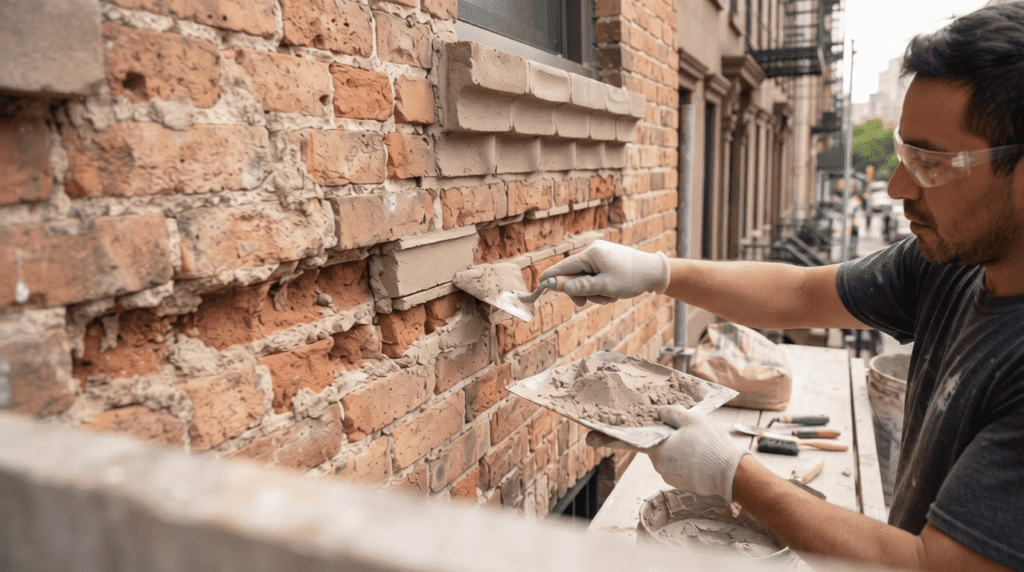
Tuckpointing is what most NYC homeowners and building owners call brick repointing — and getting it done correctly is the single most cost-effective maintenance investment you can make on a masonry building. Done properly, repointing protects the brick for the next 50–80 years. Done badly, it accelerates brick failure and tanks property value.
Need brick repointing in Brooklyn or Manhattan? Free site visit and written scope.
📞 718-666-7679
Tuckpointing vs Repointing — Are They the Same?
Strictly speaking, “tuckpointing” is a specific historical technique where a contrasting narrow band of mortar (usually white lime) is set inside a wider colored mortar joint to create the appearance of perfectly thin, uniform brickwork. It’s still done on some heritage restoration projects but is rare in modern NYC work.
In common NYC usage, “tuckpointing” and “repointing” mean the same thing: removing failed mortar from brick joints and replacing it with fresh mortar. That’s what we do — and that’s what most contractors mean when they use either term.
When Brick Walls Need Repointing
- Mortar joints are visibly recessed more than 1/4″ below the brick face
- Mortar crumbles or scrapes out easily with a screwdriver or fingernail
- Visible cracks running through joints, especially in stair-step patterns
- Loose individual bricks that move when pressed
- Mortar dust collecting on sills or window heads below the wall
- Water leaks appearing on interior walls (often a sign mortar has failed somewhere)
- Efflorescence (white salt deposits) on the brick face, indicating water movement through the wall
Why Wrong-Mortar Tuckpointing Destroys Old Brick
The most common bad-tuckpointing mistake in NYC: using hard, Portland-heavy mortar (Type S or Type M) on soft pre-war brick. Here’s why this fails:
Original NYC brick from 1880–1920 was fired at relatively low temperatures and is soft, porous, and absorbs water readily. Original mortar from that era was lime-rich and softer than the brick — by design. The mortar absorbed thermal movement and water expansion, protecting the brick.
When that wall is “repointed” with hard Portland mortar, the relationship reverses. Now the mortar is harder than the brick. Water that gets into the wall can’t escape through the harder mortar, so it stays in the brick and freezes. Brick face spalls. The Portland mortar is fine; the brick is destroyed.
Our Tuckpointing Process
- Mortar analysis. Sample the existing mortar. Identify approximate composition and color. Match it.
- Joint cutting. Grind out failed mortar to a depth of at least 2 to 2.5 times the joint width. For a typical 3/8″ joint, that’s 3/4″ to 1″ deep.
- Hand-tool finish on joint edges. We don’t freehand power grinders against the brick edges — too much damage to the brick face. Either careful guided power tools or hand chisels.
- Brush and rinse joints. Remove dust and loose mortar. Pre-wet joints before placing new mortar so old dry brick doesn’t suck moisture out of the fresh mix.
- Mix matched mortar. Portland, lime, and sand in correct ratio. Sand color matched to original — we test on-site rather than using bagged generic mortar.
- Place mortar in lifts. Deep joints in 2–3 layers rather than one fill. Single-pour deep joints shrink and crack.
- Tool joints to original profile. Concave, struck flush, weathered, V-joint, grapevine — match what’s there.
- Cure protection. Lime-bearing mortars need slow cure. Shade, mist if needed, protect from freeze.
How to Spot Bad Tuckpointing
- Smeared mortar on the brick face beyond the joint line
- Bright gray mortar on a building that originally had warm-tan or warm-gray mortar
- Wrong joint profile (concave on a building that originally had struck-flush joints, or vice versa)
- Joints that bulge proud of the brick face — they should be flush or slightly recessed
- Chipped or gouged brick edges adjacent to joints — sign of freehand power grinder work
- Caulk in joints — should never happen on a brick wall
- Visible patches where new repointing meets old — different color or texture
Cost
- Spot tuckpointing (small areas): $1,200–$4,000
- Per square foot (full wall scopes): $15–$40 per square foot
- Single elevation, row house (3–4 stories): $8,000–$25,000
- Full row house (all walls): $25,000–$100,000
- Apartment building (per sq ft with access): $20–$60 per sq ft
- Premium for Federal-era brick (pure lime mortar): +10–20%
Tuckpointing FAQs
Q: My contractor wants to use Type S mortar. Is that OK?
For 20th-century brick or brick that’s modern and hard, possibly. For 1880s–1900s NYC row house brick, no — Type S is too hard. Ask why they’re proposing it and what testing they did. If the answer is “that’s what we use” rather than a specific reason based on your brick, find another contractor.
Q: Can tuckpointing be done from inside the building?
No. The work is exterior — mortar joints are accessed from outside the wall. The joints might emerge inside if your wall has been opened for renovation, but that’s an interior masonry repair, not tuckpointing.
Q: How long does tuckpointing last?
Done correctly with proper mortar: 50–80+ years. Done with wrong mortar: 5–15 years before damage appears, then accelerating failure. The cost difference between proper and improper tuckpointing is small; the longevity difference is enormous.
Q: Can my building be partially tuckpointed?
Yes, though it’s not always cost-effective. Repointing just one wall makes sense if only that wall is failing. Repointing 30% of a single wall is rarely worth the cost of access. We help prioritize scope.
Q: Does tuckpointing fix all water infiltration?
It fixes water infiltration coming through failed mortar joints. It doesn’t fix lintel failure, parapet failure, or flashing failure. We diagnose the actual source before quoting repointing alone.
Free site visit and written tuckpointing scope.
📞 718-666-7679