
Brownstone & Mansion Restoration in Clinton Hill, Brooklyn
Brownstone & Mansion Restoration in Clinton Hill, Brooklyn
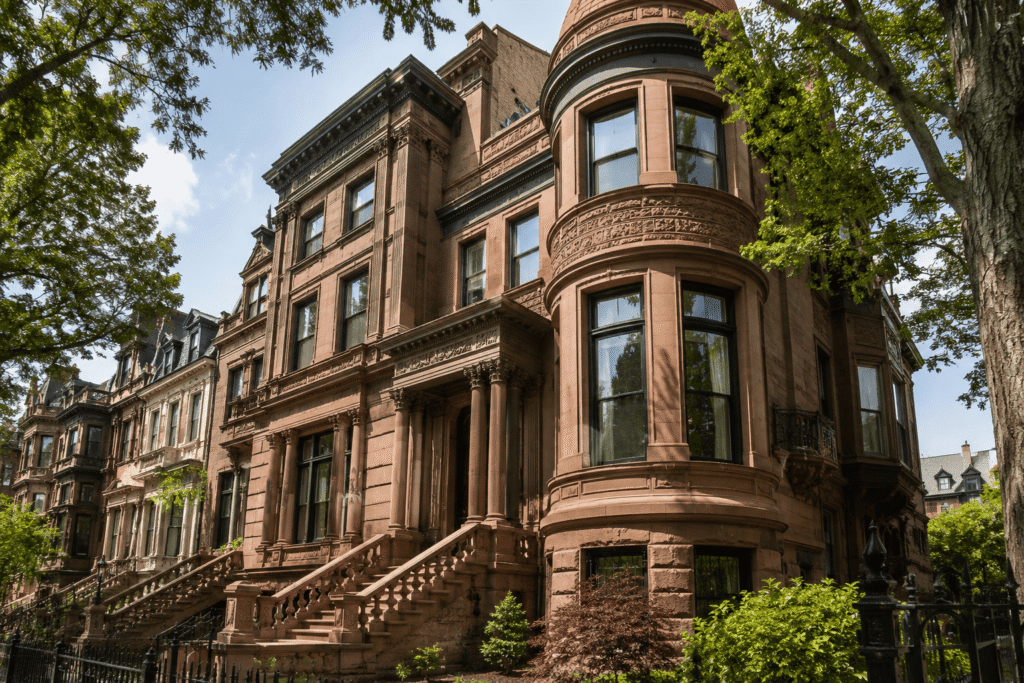
Clinton Hill was Brooklyn’s “Gold Coast” in the late 19th century — home to the Pratt family and other Brooklyn industrialists. The neighborhood has the most freestanding mansions and largest townhouses in Brooklyn outside Brooklyn Heights, alongside more typical row house blocks. Innovation Construction NY has been doing facade work in Clinton Hill since 1995, including the brownstone and limestone restoration these larger buildings require.
Clinton Hill brownstone or mansion evaluation — free.
📞 718-666-7679
Clinton Hill's Building Mix
Clinton Hill has the widest range of building scales of any Brooklyn historic district:
- Freestanding mansions on Clinton Avenue and Washington Avenue, typically 1870s–1900s, often with elaborate stone facades, towers, porte-cocheres, and large lots
- Larger row houses on the cross streets, often 22–25 feet wide (compared to standard 18–20 foot row houses)
- Standard row houses on the side streets, more typical Brooklyn brownstone scale
- Carriage houses on the avenues serving the mansions, now converted to residential use
- Some apartment buildings from the 1900s–1920s, including pre-war buildings subject to FISP
The Clinton Hill Historic District
The Clinton Hill Historic District (designated 1981) covers most of the area west of Bedford Avenue. The Wallabout Historic District (designated 2011) covers an adjacent industrial-residential area to the north. Both require LPC approval for visible exterior work.
Specific Clinton Hill Restoration Challenges
Mansion-Scale Facades
Mansion facades have more elaborate ornament than standard row houses — multiple gables, towers, terracotta panels, complex roofline geometry. Each element needs specific repair work and access often requires custom scaffolding solutions.
Multiple Materials on One Building
Many Clinton Hill mansions combine 3–4 facade materials: brownstone base, brick mid-walls, limestone trim, terracotta ornament, slate or terracotta roofing. Each material needs different repair work, coordinated so the building reads correctly.
Original Wood and Stone Carving
Mansion-scale work often includes original carved stone (capitals, friezes, ornament) and carved wood elements (porch posts, brackets, bargeboards) that need specialized restoration. We can coordinate with stone carvers and wood specialists when needed.
Setback and Yard Access
Unlike standard row houses, Clinton Hill mansions often have side yards and front setbacks. This gives us better scaffolding options but also means more facade area exposed to weather on all sides.
Common Clinton Hill Work
- Mansion-scale full facade restoration ($300,000–$1.5M+ on large projects)
- Carriage house facade and stoop work
- Standard row house brownstone restoration
- Tower and bay window restoration on Queen Anne mansions
- Pratt Institute-adjacent buildings (we’ve done work near the campus)
- Limestone and terracotta restoration on Renaissance Revival buildings
- Apartment building FISP work on the avenues
Service Area
We work all of Clinton Hill — Clinton Avenue, Washington Avenue, Vanderbilt Avenue, Waverly Avenue, Hall Street, Ryerson Street, Grand Avenue, and the cross streets from Park Avenue to Atlantic Avenue. Active in adjacent Fort Greene, Bedford-Stuyvesant, and Prospect Heights.
Cost
- Standard row house full facade: $100,000–$275,000
- Larger row house facade (22–25 ft wide): $150,000–$400,000
- Mansion-scale facade restoration: $400,000–$2M+
- Carriage house restoration: $75,000–$250,000
FAQs
Q: My Clinton Hill mansion has multiple owners (subdivided). Who manages the restoration?
Whoever owns the exterior shell — often a coop board or condo association. We work with boards, managing agents, and individual owners depending on building structure.
Q: Can complex mansion facades be restored in phases?
Yes — many Clinton Hill mansions need 3–5 year restoration programs phased by elevation and by element. We help develop the phasing plan to balance budget and access economics.
Q: How does LPC review mansion-scale work?
Mansion-scale work almost always goes to the LPC Commissioners’ public hearings (not staff-level approval) because of the scope and visibility. Expect 8–16 week review. Pre-application meetings with LPC staff often help.
Q: Can you handle a project with stone carvers and woodworkers?
Yes — we coordinate specialty trades when the scope requires them. We’re the masonry contractor; we bring in stone carvers, blacksmiths, woodworkers, and roofers when needed.