
Crown Heights Brownstone & Limestone Restoration
Crown Heights Brownstone & Limestone Restoration
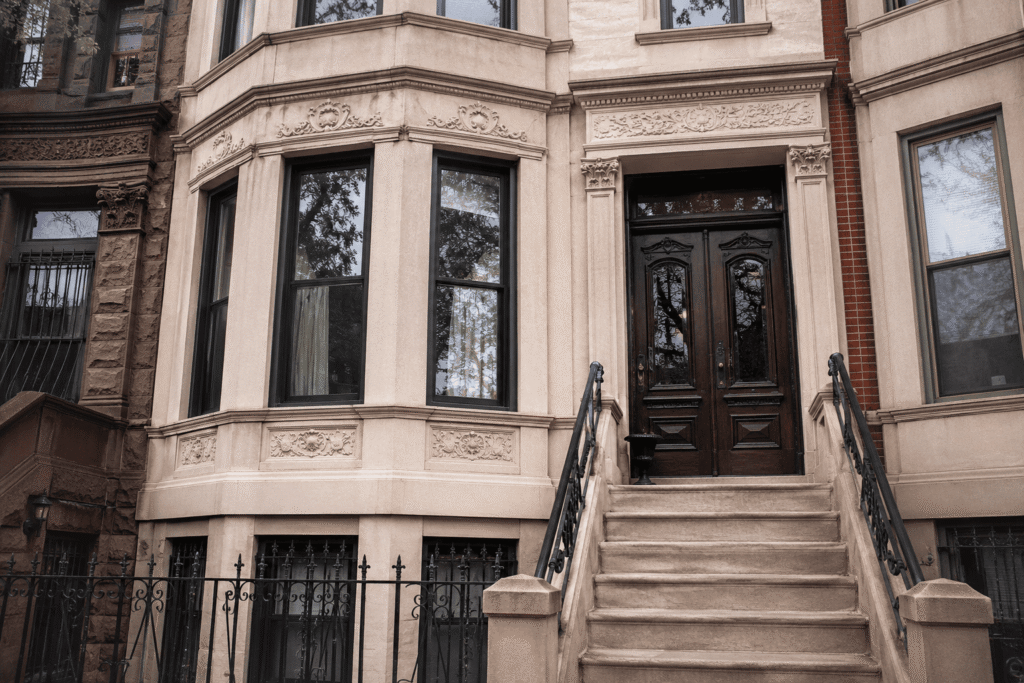
Crown Heights has more limestone row houses than any other Brooklyn neighborhood — and a different building stock profile from Park Slope or Bed-Stuy because most of it was built later (1895–1915) when limestone trim and lighter-colored facades had come into fashion. Innovation Construction NY restores Crown Heights houses with the right materials for the right building era.
Crown Heights facade evaluation — free.
📞 718-666-7679
Crown Heights' Distinctive Building Stock
Most Crown Heights row houses date from 1895 to 1915 — significantly later than Park Slope (1880s–1890s) or Bed-Stuy (1870s–1900s). This means:
- More limestone than brownstone, often in combination with Roman brick
- Renaissance Revival style dominance with classical ornament
- Some Romanesque Revival on the earlier blocks with rough-faced stone
- Wider lots than 1880s neighborhoods — often 22–25 feet
- Harder original brick than 1870s neighborhoods (firing improved over the decades)
- Some apartment buildings from the 1900s–1920s on the avenues
Historic Districts in Crown Heights
- Crown Heights North Historic District (designated 2007, extended multiple times)
- Crown Heights North II Historic District (2011)
- Crown Heights North III Historic District (2015)
The district designations are relatively recent compared to Park Slope (1973) or Brooklyn Heights (1965), so a lot of Crown Heights buildings have been altered over the decades without LPC oversight. Restoring to historically appropriate appearance is often a significant scope item.
What Crown Heights Restoration Looks Like
Limestone Cleaning
The light-colored limestone facades show dirt and gypsum buildup heavily — and many were painted over decades ago. Restoration usually starts with chemical poultice cleaning or micro-abrasive cleaning (JOS/TORC) to remove dirt and any prior paint. Done right, you get back to the original cream-colored limestone the building was built with.
Limestone Repair
Lime-based patching compound for damaged areas, dutchman repair with matched limestone for larger failures. Never Portland-based products on limestone — they damage the host stone over time.
Roman Brick Repointing
Many Crown Heights houses have long, thin “Roman” brick — the mortar joint is a higher percentage of the wall area than standard brick, so repointing quality is more visible. Color matching and joint profile have to be exact.
Stoop and Areaway Restoration
Crown Heights stoops are often limestone or limestone-trimmed rather than full brownstone. Restoration uses different materials than Park Slope or Bed-Stuy work.
Original Cast-Iron Work
The newer 1900s buildings often have more elaborate original wrought-iron and cast-iron work — areaway gates, stoop railings, basement window guards — than older neighborhoods. We preserve and restore these.
Apartment Building Work
The avenues — Eastern Parkway, Bedford Avenue, Nostrand Avenue, Franklin Avenue — have a lot of 1900s–1920s apartment buildings. Many are subject to Local Law 11 / FISP. See our FISP page for that work.
Service Area
We work all of Crown Heights — Eastern Parkway, President Street, Carroll Street, Crown Street, Montgomery Street, Sterling Place, St. John’s Place, Park Place, Prospect Place, Bergen Street, and cross streets from Washington Avenue to Ralph Avenue. Active in adjacent Prospect Heights, Bed-Stuy, and Flatbush.
Cost
- Limestone cleaning (full row house): $15,000–$40,000
- Limestone restoration (full facade): $90,000–$275,000
- Stoop restoration: $10,000–$30,000
- Apartment building FISP scope: see cost page
FAQs
Q: My Crown Heights house is painted. Can it be returned to limestone?
Usually yes, with chemical paint removal. It’s a significant project — paint removal alone can be 30–50% of total restoration cost. Worth it for property value and historic character.
Q: How do I know if my building is in a Crown Heights historic district?
Check the LPC map at nyc.gov/lpc or call us with the address. The districts are large but don’t cover the whole neighborhood.
Q: My limestone is gray and dirty but I don’t want to clean it — is that OK?
Cosmetically, sure — though property value benefits from cleaning. Functionally, the gypsum crust that develops on dirty limestone is mildly acidic and slowly damages the stone. Cleaning is also a maintenance issue, not just aesthetic.
Q: Can you do cleaning without scaffolding?
For ground-floor and stoop areas, yes. For full-facade cleaning on a 3–4 story row house, we need scaffold or swing stage. Cost is comparable to repointing scope.