
Crumbling Mortar and Spalling Brick — Causes and Proper Repair in NYC
Crumbling Mortar and Spalling Brick — Causes and Proper Repair in NYC
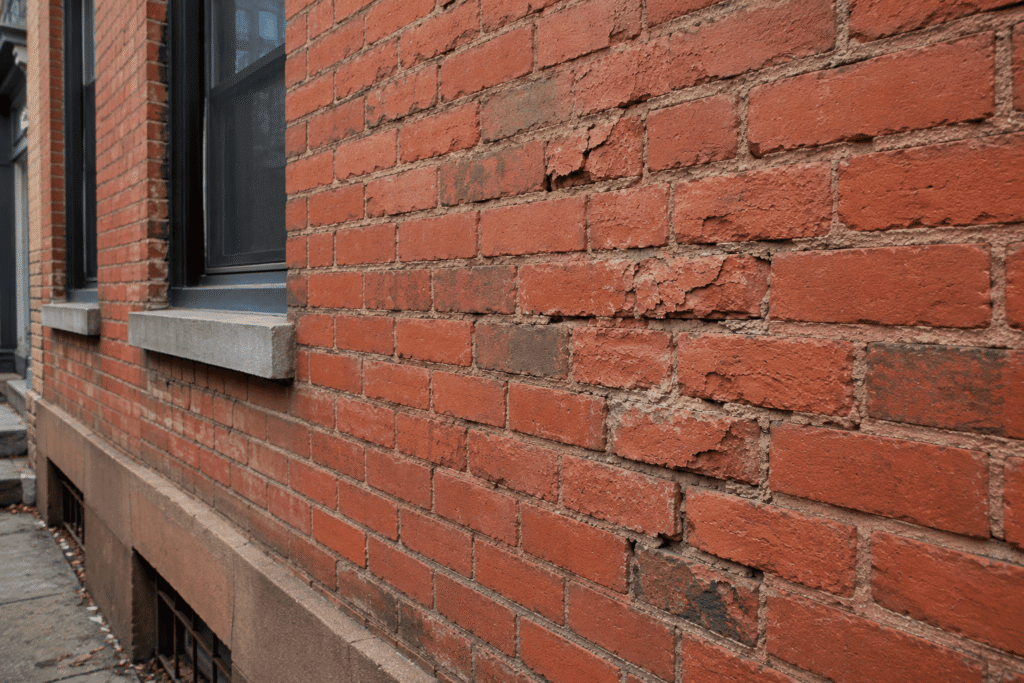
If you can scrape mortar out of the joints with a screwdriver, or if you’re finding flakes of brick on the sidewalk below the facade, the wall is telling you it needs work. Both problems — failed mortar joints and spalling brick faces — are common on NYC’s older masonry buildings, and both have specific causes that the repair has to address. Patching the symptoms doesn’t fix the underlying problem.
This page covers what causes mortar and brick to fail, what proper repair looks like, and how to avoid the most common mistakes contractors make on this work.
Mortar joints crumbling or brick face flaking? We’ll come look and tell you what’s going on.
📞 718-666-7679 | 212-666-5441
What Crumbling Mortar Actually Means
Mortar is designed to be the sacrificial element in a brick wall. It’s softer than the brick by design — the wall expands and contracts with temperature and moisture, and the mortar absorbs the movement so the brick doesn’t crack. Over decades, the mortar erodes from weather exposure, and eventually it needs to be replaced. This is called repointing (also “pointing” or “tuckpointing” in some regions).
Normal mortar life in NYC is roughly 50–80 years before significant repointing is needed. Walls that are still on their original 1880s mortar are overdue. Walls that were repointed in the 1960s–80s with hard Portland mortar may be failing again — sometimes worse than before — because the wrong mortar was used.
How to Tell If Your Mortar Is Failing
- Joints are recessed deeper than 1/4″ below the brick face — mortar has eroded back into the joint.
- You can scrape mortar out with a screwdriver or even a fingernail.
- Visible cracks running through joints, especially in step patterns.
- Mortar dust visibly accumulating on sills or window heads below the wall.
- Sections of mortar missing entirely with visible voids in the joints.
- Loose bricks that move when pressed.
What Spalling Brick Means
Spalling is when the outer fired surface of a brick — the “skin” — flakes or pops off, exposing the much softer and more porous interior of the brick. Once spalling starts on a brick, it accelerates: water gets into the exposed interior more easily, freezes, expands, and breaks off more brick face.
What Causes Spalling
- Freeze-thaw on saturated brick. Water gets into the brick, freezes, expands ~9%, and breaks the brick from the inside out. This is the most common cause.
- Wrong-strength mortar. Hard Portland mortar (Type S or stronger) on soft pre-war brick traps water inside the brick because water can’t escape through the harder mortar. Result: brick spalls instead of mortar weathering normally.
- Sandblasting damage. Aggressive abrasive cleaning strips the fired outer skin off the brick, leaving the soft interior exposed. Sandblasted walls spall systematically within a few years.
- Acid washing. Strong acid solutions used to clean brick can damage the surface and accelerate spalling.
- Salt damage. Sidewalk and step de-icing salts wick up into the lower courses of brick and cause crystalline pressure that spalls the face.
- Water sources from above. Failed parapet, coping, or roof flashing that drives water into the wall from the top.
Critical: if your brick is spalling and the mortar isn’t, the problem is the mortar — counterintuitively. Hard mortar around soft brick forces the brick to take all the freeze-thaw movement and water permeation that the mortar should be absorbing.
Proper Repointing — What Should Happen
Real repointing is more involved than most people realize:
- Diagnose first. What’s the original mortar composition? What’s the brick type and age? Has the wall been repointed before, possibly with the wrong material?
- Cut out failed mortar to proper depth. Minimum 2 to 2.5 times the joint width — so for a typical 3/8″ joint, the mortar comes out to 3/4″ to 1″ deep. Anything shallower won’t bond properly.
- Cut out with hand tools, not power grinders. Or only with careful guided power tools by experienced masons. Freehand angle grinders chew up the brick edges and ruin the joint geometry. We see this constantly on cheap repointing jobs.
- Match the original mortar composition. For most pre-1900 NYC brick buildings, that’s Type N (1:1:6 portland:lime:sand) or Type O (1:2:9, lime-rich). Federal-era buildings (1820s–1840s) often need pure lime mortar. Never use Type S or M on old soft brick.
- Match color and sand type. Mortar color comes from the sand and any pigment. Original mortars used local sands — typically warm yellow or reddish-tan on NYC buildings, not the cool gray of modern bagged mortar. We test sand colors and pigment ratios before committing.
- Pre-wet the joints before placing new mortar. Dry old brick sucks moisture out of fresh mortar and prevents proper cure.
- Place mortar in two or three lifts for deep joints, not one. Single-lift deep joints develop shrinkage cracks.
- Tool the joint to match the existing profile. Concave, struck flush, weathered, grapevine, V-joint — the joint shape on your building is part of its character.
- Protect from weather during cure. Fresh lime-bearing mortars need to cure slowly and not freeze. Cold-weather repointing requires special precautions.
Repairing Spalled Brick
Diagnose the Underlying Cause
Spalled brick can be addressed in several ways depending on severity:
Replace the Brick
For badly spalled brick where more than 1/4″ of the face is lost, the right answer is removing and replacing the brick. We source salvaged brick that matches the original — color, size, texture — or for repairs in less-visible areas, modern brick that approximates the original. Whole-brick replacement is more durable than face-only repair.
Brick Face Repair (Limited Cases)
For lightly spalled brick in non-critical areas, the face can be patched with brick-matching cementitious compound. This is a stopgap rather than a real repair — it bonds to the back of the spalled area but has a different texture and porosity than real brick. We use it sparingly and never as a primary solution.
Address the Cause
Spalling is always a symptom of something — wrong mortar, water source, or sandblasting damage. The brick repair only lasts if the underlying cause is also addressed. This is why we often combine spall repair with broader repointing or waterproofing work.
What Bad Repointing Looks Like — How to Spot It
- Smeared mortar on the brick face. Mortar that’s been spread over the brick face beyond the joint, often visible as gray staining. Sign of rushed work.
- Joints that bulge out beyond the brick face. Should be flush or slightly recessed, never proud.
- Wrong color. Bright gray mortar on a building that originally had warm-tan mortar reads wrong from the street.
- Wrong profile. Concave joints on a building that originally had struck-flush joints.
- Joints filled with caulk. Should never happen on a brick wall.
- Power-grinder damage on the brick edges. Look closely at the brick adjacent to the joints — chips, gouges, and grooves indicate freehand grinder work.
Typical Costs in NYC
- Spot repointing (small areas, localized): $1,200–$4,000
- Single-wall repointing (one full elevation of a row house): $8,000–$25,000
- Full-building repointing (all four walls of a row house): $25,000–$100,000+
- Brick replacement: $25–$60 per brick installed, including source-matching
- Brick face repair: $30–$80 per square foot, very limited use cases
Apartment building scopes are typically much larger and access (suspended scaffold, swing stage, mast climbers) drives a significant share of cost.
Frequently Asked Questions
Q: How urgent is repointing? Can it wait a year or two?
Depends on how bad the failure is. Mortar that’s recessed but still solid in the joint can wait. Joints with significant voids, missing sections, or loose bricks need attention before the next winter — freeze-thaw cycles accelerate damage rapidly once the wall is letting water in.
Q: Should I get my whole building repointed at once?
If most of the wall needs it, yes — it’s cheaper per square foot at scale than coming back for spot repairs every few years. If only one elevation is failing (often the south or west weather-exposed face), repointing that one wall makes sense.
Q: Can my building be repointed in winter?
Possible but not ideal. Mortar needs to cure above freezing for several days. Winter repointing requires enclosures, heaters, and careful timing — it costs more and the results aren’t quite as good. We schedule major repointing for April through October when possible.
Q: Is repointing covered under home insurance?
Generally no — it’s considered routine maintenance, not sudden damage. Exceptions: if a specific event (storm, vehicle impact) caused the damage. For Local Law 11 / FISP-mandated repointing on apartment buildings, the cost is typically the building’s responsibility and funded through reserves or special assessment.
Q: Will newly repointed mortar match the rest of the building?
Done correctly, yes. We mix mortar on-site, test small sample patches, and adjust until the color, texture, and joint profile match the existing. Done incorrectly, repointed sections stand out for the life of the building. The difference is in the prep, not the price.
Q: What if my building was repointed wrong 20 years ago?
The right move is removing the failed Portland mortar and replacing with proper soft mortar. It’s more expensive than original repointing because the hard mortar is harder to extract, but it’s the only way to stop ongoing brick face spalling caused by the wrong-mortar problem.
Get a real evaluation, not a sales pitch.
📞 718-666-7679 | ✉️ innovation.construction@yahoo.com