
Harlem Brownstone & Facade Restoration
Harlem Brownstone & Facade Restoration
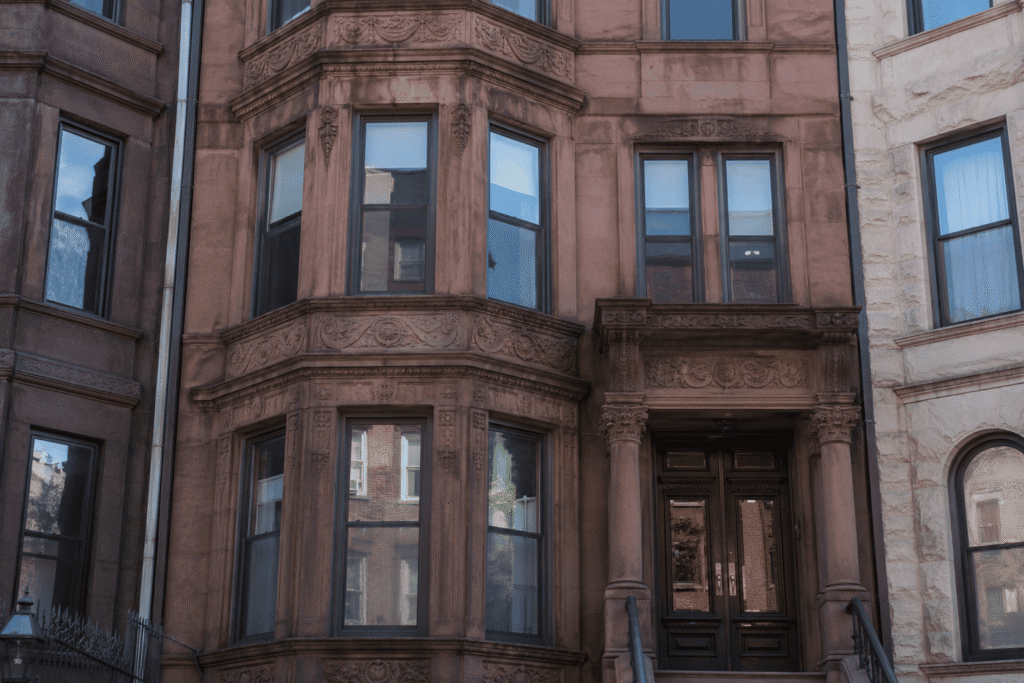
Harlem has some of the most architecturally significant row houses in New York City — the McKim, Mead & White ensemble at Striver’s Row, the Stanford White houses on West 138th Street, the elaborate Romanesque and Renaissance Revival row houses around Mount Morris Park, and the limestone-trimmed houses of Hamilton Heights and Sugar Hill. Innovation Construction NY has been restoring Harlem facades since 1995 and we know what these specific buildings need.
Harlem brownstone or limestone evaluation — no obligation, no upsell.
📞 212-666-5441
Harlem's Historic Districts
Harlem has multiple LPC-designated historic districts, each with its own character:
- Mount Morris Park Historic District (designated 1971, extended 2015) — late-Victorian row houses around Marcus Garvey Park, lots of brownstone with Romanesque Revival ornament.
- St. Nicholas Historic District (Striver’s Row) (designated 1967) — the McKim, Mead & White and other firms’ ensemble on West 138th and 139th Streets between Frederick Douglass and Adam Clayton Powell Boulevards. Brick, limestone, and brownstone facades, some of the most refined work in the city.
- Hamilton Heights Historic District (1974, extended 2000) — late-19th-century row houses, often with limestone trim over Roman brick.
- Sugar Hill Historic District (2000, 2002) — upper Harlem, mix of row houses and early apartment buildings.
- Harlem Renaissance / 130s and 140s blocks with various individual landmark designations.
If you’re in any of these districts, LPC permits are required for exterior work. Even if you’re not in a designated district, much of Harlem is being considered for future designation and working to LPC standards now protects your house’s future value.
What Makes Harlem Restoration Specific
More Limestone Than Most Brownstone Neighborhoods
While “brownstone” is the universal shorthand for these houses, a significant share of Harlem row houses are actually limestone facades or brownstone with limestone trim. Limestone behaves differently from brownstone — it’s harder, doesn’t spall the same way, but is vulnerable to acid rain and atmospheric pollution that creates a gypsum crust on the surface. Cleaning limestone correctly requires careful pH-buffered methods, not aggressive acid washes that strip the patina along with the dirt.
Mixed-Material Facades
Many Harlem houses combine brownstone bases, brick mid-sections, and limestone or terracotta trim around windows and at the cornice. Each material needs different repair work, and they have to be coordinated so the colors and finishes read correctly together when the scaffolding comes down.
Apartment Buildings Mixed with Row Houses
Unlike Park Slope or Bed-Stuy where row houses dominate, Harlem has many 6–8 story pre-war apartment buildings on the avenues, often with elaborate masonry facades. These buildings are subject to Local Law 11 / FISP and we do that work as well.
Painted Brick
Many Village houses have been painted (often multiple times) over the past century. Removing paint to return to original brick requires LPC approval and is a significant project — chemical poultice systems applied in stages, never sandblasting (which destroys soft Federal-era brick).
Common Harlem Restoration Work
Brownstone Facade Resurfacing
Same fundamentals as Brooklyn brownstone work — strip back to sound stone, resurface with color-matched restoration compound, restore detail and texture. Many Harlem facades have specific decorative details (egg-and-dart moldings, leaf carvings, lion’s-head keystones) that require careful hand-tooling to reproduce.
Limestone Cleaning and Repair
For limestone facades, the right cleaning method is critical. We use chemical poultice systems and JOS/TORC-type micro-abrasive methods (when appropriate and LPC-approved) — never wet sandblasting, which destroys the limestone surface. Repairs use lime-based patching compound, not Portland-based products.
Brick Repointing
Many Harlem houses combine Roman brick (long, thin brick) with limestone trim. Repointing Roman brick is more visible than standard brick because the joints are a higher percentage of the wall area — mortar color and joint profile have to be exactly right.
Cornice Restoration
Harlem has both sheet-metal cornices and terracotta cornices, sometimes on the same building. We repair both. Missing terracotta sections can be reproduced in cast stone matched to the originals.
Stoop Restoration
Harlem stoops range from modest 3–4 step approaches to the grand 8–10 step stoops on the larger row houses. We restore brownstone treads, rebuild failed cheek walls, restore or replace cast-iron railings, and address the connection between stoop and house where water typically gets in.
Local Law 11 / FISP Work on Apartment Buildings
For pre-war apartment buildings subject to FISP, we handle the masonry, lintel, parapet, and waterproofing repair work that follows from QEWI reports. See our Local Law 11 / FISP page for more.
Service Area
We work throughout Harlem including Mount Morris Park, Hamilton Heights, Sugar Hill, Striver’s Row, Astor Row, Le Petit Senegal, East Harlem (El Barrio), Manhattanville, and adjoining neighborhoods. Major streets we’ve worked on include West 116th through West 145th Streets, Lenox Avenue, Adam Clayton Powell Boulevard, Frederick Douglass Boulevard, Convent Avenue, St. Nicholas Avenue, Edgecombe Avenue.
Frequently Asked Questions
Q: My Harlem house is in Mount Morris Park Historic District. How does LPC approval affect timeline?
For typical in-kind repair work — repointing, brownstone restoration, stoop repair — staff-level approval generally runs 3–8 weeks. We file LPC applications the same week we contract so the approval process runs in parallel with mobilization.
Q: Can you clean a limestone facade without damaging it?
Yes — the key is using the right method. We use chemical poultice cleaning or micro-abrasive systems (JOS/TORC) depending on the building and what LPC approves. Standard pressure-washing or sandblasting destroys limestone and we don’t do that.
Q: My building was painted decades ago. Should I remove the paint?
If the paint is failing, yes — no patch will hold to a deteriorating surface. If the paint is sound but historically inappropriate, it’s a judgment call between historic accuracy and budget. Paint removal in Harlem is a serious project, typically $50,000–$150,000+ on a single house just for the strip-and-prep before any repair work begins.
Q: How much does Harlem brownstone restoration cost?
Stoop only: $10,000–$30,000. Partial facade work: $35,000–$90,000. Full single-family facade restoration: $125,000–$350,000+. Pre-war apartment building FISP work: $50,000 to $1M+ depending on scope.
Q: Do you work on the Striver’s Row houses?
Yes. Striver’s Row is in the St. Nicholas Historic District and any work requires LPC approval. We’ve done restoration work on row houses in this area and understand the level of detail and craftsmanship required.
Harlem facade evaluation — free. Call or email and we’ll come out to look.
📞 212-666-5441