
Limestone Restoration in NYC
Limestone Restoration in NYC
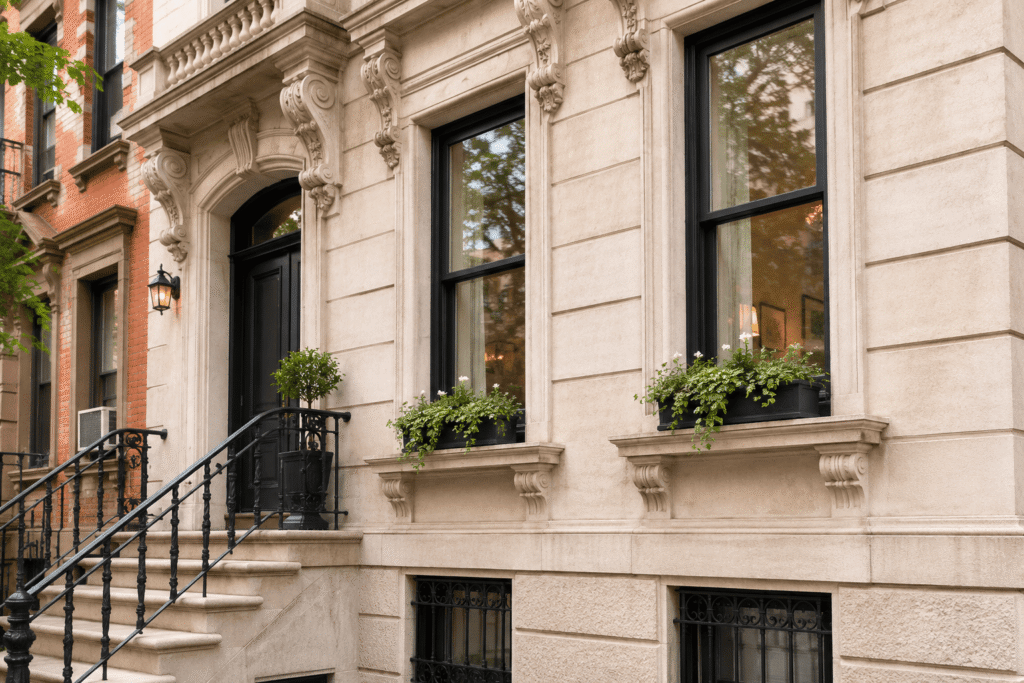
Limestone is harder, denser, and longer-lasting than brownstone — but it has its own failure modes, and the cleaning and repair methods that work for brownstone destroy limestone. Innovation Construction NY restores limestone facades on Brooklyn and Manhattan pre-war buildings, from Renaissance Revival row houses in Bed-Stuy to Beaux-Arts apartment buildings on the Upper West Side.
Limestone facade evaluation — free site visit.
📞 212-666-5441
What Limestone Is
Limestone is a sedimentary rock composed primarily of calcium carbonate. NYC’s pre-war limestone facades most commonly used Indiana limestone (the dominant American building limestone, quarried in southern Indiana since the 1800s), with some buildings using French limestone, Alabama limestone, or other sources. Compared to brownstone, limestone is harder (5–7x), denser, less porous, and weathers more uniformly.
Common NYC Buildings With Limestone Facades
- Renaissance Revival row houses (1890s–1900s) in Bed-Stuy, Crown Heights, Harlem, and Hamilton Heights — typically Indiana limestone facades or limestone trim over brick
- Beaux-Arts and neo-classical apartment buildings on the Upper West Side, Upper East Side, and Central Park West
- Many commercial buildings in Midtown and Lower Manhattan
- Landmark structures including parts of the Brooklyn Museum, the New York Public Library, and many bank buildings
How Limestone Fails
Black Crust (Gypsum)
The most common limestone problem in NYC. Acid rain reacts with the calcium carbonate in limestone, forming calcium sulfate (gypsum) on the surface. Gypsum traps dirt, creating the characteristic black crust on protected areas of limestone facades (under window sills, beneath cornices, in shadow areas). The crust isn’t just dirt — it’s a chemical alteration of the surface that’s hard to remove without damaging underlying stone.
Surface Sugaring
Severely weathered limestone loses its surface coherence, developing a gritty, sugar-like texture as the bonds between calcium carbonate crystals break down. Often caused by past aggressive cleaning, freeze-thaw, or acid attack.
Spalling
Many Village houses have been painted (often multiple times) over the past century. Removing paint to return to original brick requires LPC approval and is a significant project — chemical poultice systems applied in stages, never sandblasting (which destroys soft Federal-era brick).
Cracking
Limestone cracks at structural movement points, around embedded metal that has rusted, and at coping/cornice intersections.
Differential Weathering
Wind-driven rain wears down exposed sections while protected areas accumulate dirt and gypsum. Over decades, this creates the dramatic light/dark pattern characteristic of weathered limestone.
Cleaning Limestone — What Works and What Destroys It
Critical: sandblasting, aggressive pressure washing, and strong acid cleaning all destroy limestone permanently. We see “restored” limestone buildings where prior contractors used these methods and the stone is now far worse than before they touched it.
Approved Cleaning Methods
- Chemical poultice cleaning: alkaline or neutral chemical pastes applied to the stone, allowed to draw out staining and gypsum, then rinsed. Multiple application cycles for heavy soiling.
- Micro-abrasive cleaning (JOS, TORC, ThermaTech): low-pressure systems using fine inert aggregate or hot water mist to clean without surface damage. LPC-approved on many landmark buildings.
- Steam cleaning: low-pressure superheated water for light soiling.
- Hand cleaning: bristle brushes and pH-buffered detergents for sensitive areas.
Never Used on Limestone
- Sandblasting (destroys stone face)
- High-pressure water washing (above 1000 psi)
- Hydrochloric acid or muriatic acid (strips calcium carbonate)
- Sodium hydroxide solutions stronger than necessary for the specific staining
Limestone Repair Methods
Dutchman Repair
For localized damage, cut out the failed area in a clean geometric shape and inset a new piece of matched limestone. Mechanically attached, set in lime-based mortar, color and texture matched to surrounding stone. Done well, nearly invisible.
Lime-Based Patching
For smaller areas where dutchman repair isn’t practical, lime-based patching compound applied in layers, hand-tooled to match texture. Never use Portland-based products on limestone — they’re harder than the host stone and trap moisture inside it.
Stone Consolidation
For sugaring or weakened stone surfaces, silane or tetraethyl orthosilicate (TEOS) consolidants penetrate into the stone and re-bind loose surface crystals. Doesn’t change appearance. Effective for early-stage degradation.
Embedded Metal Removal
Where cracking is caused by rusted iron cramps or anchors, the metal must be removed before the crack repair will hold. Stainless steel replacement anchors set in lime mortar.
Surface Sealing
After cleaning and repair, breathable siloxane water repellents can extend service life. Never use film-forming sealers (acrylics, urethanes) — they trap moisture and accelerate damage.
Cost
- Limestone cleaning (chemical poultice): $15–$35 per square foot
- Micro-abrasive cleaning (JOS/TORC): $20–$50 per square foot
- Dutchman repair (per piece): $1,000–$3,500 depending on size and detail
- Lime-based patching (per square foot): $80–$200
- Stone consolidation (per square foot): $15–$40
- Full row house limestone restoration: $80,000–$300,000+
- Apartment building limestone facade restoration: $500,000–$5M+
Limestone Restoration FAQs
Q: My limestone is gray and dirty. Can it be returned to its original light color?
Usually yes, with proper chemical or micro-abrasive cleaning. Results depend on how deep the gypsum crust has penetrated and whether the underlying stone has been damaged by prior bad cleaning. We test small sample patches before committing to full-facade cleaning so you can see the expected result.
Q: Can limestone be cleaned without scaffolding?
For ground-floor work, yes — ladder or aerial lift access. For full-facade cleaning, scaffolding or swing stage is needed. Full-perimeter apartment building work requires significant access infrastructure.
Q: Will the cleaning damage other materials on the facade (brick, terracotta, metal)?
Different materials need different cleaning. We mask and protect adjacent materials during limestone cleaning, then address each material with its appropriate method.
Q: My building has limestone trim over brick. Is that brownstone or limestone?
Limestone trim over brick is limestone — the brick is a separate material. Many NYC apartment buildings combine these. We treat each material appropriately.
Q: How often does cleaned limestone need to be re-cleaned?
Depends on location and air pollution exposure. In current NYC conditions, properly cleaned and sealed limestone holds up well for 15–25 years before significant re-soiling. Maintenance washing (gentle, low-pressure) every 5–10 years extends this further.
Limestone facade evaluation — free site visit and honest scope.
📞 212-666-5441