
Local Law 11 / FISP Facade Repair in NYC
Local Law 11 / FISP Facade Repair in NYC
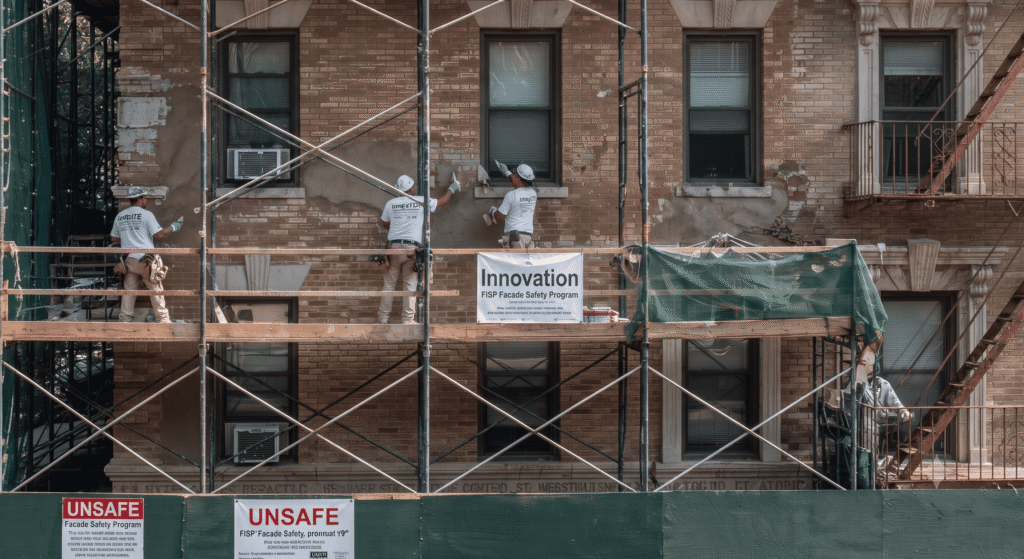
Innovation Construction NY is a licensed Brooklyn-based masonry contractor specializing in the repair work required by Local Law 11 (FISP) inspection reports. If your building has been classified Unsafe or SWARMP by your QEWI, we handle the corrective work — brick repointing, lintel and parapet repair, brownstone and limestone restoration, stucco and waterproofing — across Brooklyn and Manhattan. We’ve been doing this since 1995.
FISP report in hand? Send us the marked-up photos and the QEWI’s repair list. We’ll come look at the facade, give you a written scope and price, and get the work scheduled before your filing deadline.
📞 212-666-5441 | 718-666-7679
What Is Local Law 11 (FISP)?
Local Law 11 — officially the Facade Inspection Safety Program (FISP) under NYC Administrative Code §28-302 — requires every NYC building taller than six stories to have its exterior walls and appurtenances inspected by a Qualified Exterior Wall Inspector (QEWI) every five years. The QEWI files a report with the Department of Buildings classifying each facade and condition as:
- SAFE — no repair needed.
- SWARMP (Safe With A Repair and Maintenance Program) — defects that aren’t immediately dangerous but must be corrected before the next cycle’s filing deadline, or they automatically downgrade to Unsafe.
- UNSAFE — hazardous conditions requiring immediate public protection (sidewalk shed, netting, or fencing) and repair within 90 days of the filing.
The QEWI inspects and reports. A separate licensed contractor — that’s us — performs the physical repair work. Most building owners don’t realize these are two different roles until they’re handed a report and told to “fix it.”
Current Cycle: Cycle 10 (2025–2030)
The current FISP cycle is Cycle 10, which runs from February 21, 2025 through February 21, 2030. Your specific filing window depends on the last digit of your building’s block number:
| Sub-cycle | Block number ends in | Filing window |
|---|---|---|
| 10A | 4, 5, 6, or 9 | Feb 21, 2025 – Feb 21, 2027 |
| 10B | 0, 7, or 8 | Feb 21, 2026 – Feb 21, 2028 |
| 10C | 1, 2, or 3 | Feb 21, 2027 – Feb 21, 2029 |
If your Cycle 9 SWARMP conditions weren’t repaired, they automatically become Unsafe at the close of your Cycle 10 sub-cycle. That triggers DOB violations, monthly fines, and sidewalk-shed requirements. We see this every cycle — boards who deferred repairs in 2020 are now facing emergency work in 2026.
FISP Repair Work We Perform
Brick Repointing & Repair
The single most common SWARMP condition on NYC facades. Mortar joints deteriorate, water gets behind the masonry, and freeze-thaw cycles spall the brick face. We grind out failed joints to a proper depth (minimum 2× joint width), match the existing mortar in color and composition (Type N for most pre-war buildings, never Type S unless required), and re-tool joints to match the original profile — concave, grapevine, weathered, or struck flush depending on what’s there.
Brownstone & Limestone Facade Repair
Brownstone is essentially compressed sandstone, and it spalls badly when water gets in. We use restoration-grade brownstone compound (color-matched to your building) for dutchman repairs, full-resurfacing where needed, and ornamental restoration on cornices, window surrounds, and stoops. Limestone repair uses lime-based compatible patching material.
Lintel & Sill Replacement
Steel lintels rust, expand, and crack the masonry above windows — one of the most common Unsafe findings. We remove the rusted lintel, install a new galvanized or stainless steel lintel, rebuild the masonry above, and waterproof the assembly so it doesn’t happen again in five years.
Parapet Wall Repair & Rebuild
Parapets fail more often than any other facade element because they’re exposed on both sides. We rebuild loose or leaning parapets, replace coping stones, install through-wall flashing, and waterproof the back side.
Cornice Repair
Sheet-metal cornices rust through; terracotta cornices crack and spall. We repair both — welding and re-galvanizing metal cornices, or removing and recreating damaged terracotta sections with cast stone matched to the original.
Stucco & Waterproofing
For stucco facades, we strip failed sections back to sound substrate, patch with compatible cementitious stucco, and apply breathable waterproof coatings. For mass masonry walls, we apply siloxane-based breathable sealers — never film-forming sealers that trap moisture inside the wall.
Penalties for Non-Compliance — What You're Actually Risking
The current FISP cycle is Cycle 10, which runs from February 21, 2025 through February 21, 2030. Your specific filing window depends on the last digit of your building’s block number:
| Violation | Penalty |
|---|---|
| Late filing of initial report | $1,000 per month, retroactive to deadline |
| Failure to file | $5,000 per year |
| Unsafe condition — ECB base penalty | $5,000 (up to $25,000) |
| Failure to correct Unsafe conditions | $1,000 per month, ongoing |
| Failure to correct SWARMP by next cycle | $2,000 + automatic Unsafe downgrade |
| Mandatory sidewalk shed (Unsafe buildings) | $40–$100 per linear foot per month |
If your Cycle 9 SWARMP conditions weren’t repaired, they automatically become Unsafe at the close of your Cycle 10 sub-cycle. That triggers DOB violations, monthly fines, and sidewalk-shed requirements. We see this every cycle — boards who deferred repairs in 2020 are now facing emergency work in 2026.
Our Process for FISP Repair Projects
- Send us your FISP report. Email the photos and the QEWI’s repair list to innovation.construction@yahoo.com. We need the actual report — not just a description — because the language the QEWI uses dictates how DOB will close the violation.
- On-site walkthrough. We come out, verify what the QEWI documented, and identify anything they missed that will become Unsafe before the next cycle. Better to address it once with the scaffold up than pay for access twice.
- Written scope and price. Line-itemed by condition, with unit pricing where it makes sense (repointing per square foot, lintel replacement per opening, etc.). No vague “facade restoration” line items.
- Coordination with your QEWI. We work directly with your QEWI so the as-built repair matches what gets filed in the amended report. Mismatched scope-to-filing is the #1 reason amended reports get rejected.
- Permitting and protection. We pull the work permits, install required pedestrian protection, and handle the sidewalk-shed contractor if one’s needed.
- Repair execution. Our own crews — no subbed-out masonry work. Photos taken before, during, and after for the QEWI’s amended filing.
- Amended report support. We provide the QEWI with the documentation needed for the amended FISP filing that gets your status returned to Safe and your sidewalk shed taken down.
Why a Specialized Masonry Contractor Matters for FISP
FISP repair is not general construction. A few specifics most owners don’t know until they hire the wrong contractor:
- Mortar composition matters legally, not just aesthetically. A pre-war brick building repointed with Portland-heavy Type S mortar will spall worse in 5 years than it did before the repair, and the QEWI will flag it on the next cycle.
- Landmarks Preservation Commission (LPC) districts have material and method requirements that override standard masonry practice. If your building is in a historic district — Brooklyn Heights, Park Slope, Cobble Hill, Carroll Gardens, Fort Greene, Clinton Hill, Crown Heights North, Greenwich Village, Upper East Side Historic District, Upper West Side / Central Park West, Hamilton Heights, Mount Morris Park, and many others — your contractor needs to file separately with LPC and use approved materials. We do this routinely.
- Cavity wall investigation is required on alternating FISP cycles for cavity-wall buildings. If your QEWI calls for probes, the masonry contractor opens them and reseals them — that’s our work, not the inspector’s.
- Amended report timing. The 60-day window after final inspection to file the amended report means the masonry work has to be photo-documented in real time, not reconstructed after the fact.
Service Areas for FISP Work
We perform FISP repair work in all five boroughs, with the bulk of our work in:
Brooklyn: Park Slope, Brooklyn Heights, Bedford-Stuyvesant, Carroll Gardens, Cobble Hill, Fort Greene, Clinton Hill, Crown Heights, Williamsburg, Prospect Heights, Windsor Terrace, Downtown Brooklyn, Sunset Park.
Manhattan: Upper West Side, Upper East Side, Harlem, Hamilton Heights, Chelsea, Greenwich Village, West Village, East Village, Lower East Side, Murray Hill, Midtown, Washington Heights, Inwood, Morningside Heights.
Frequently Asked Questions
Q: How do I find out if my building is subject to FISP?
If your building is taller than six stories anywhere in NYC, it is. You can confirm your filing cycle by looking up your block number on the DOB Building Information System (BIS) or NYC’s ACRIS portal. The last digit of your block number determines your sub-cycle.
Q: How much does FISP repair work actually cost?
It depends entirely on what your QEWI flagged, the building size, and access. A SWARMP-rated building with localized repointing and a few lintel repairs might run $25,000–$75,000. A building with full parapet rebuilds, multiple Unsafe lintels, brownstone spalling across the facade, and shed-required access can run $150,000–$500,000+. We give a flat written price after walking the building — no surprises.
Q: My building was rated Unsafe. How fast do I need to act?
Public protection (sidewalk shed, fencing, or netting) needs to go up immediately — within days, not weeks. DOB requires unsafe conditions corrected within 90 days of the FISP filing, though extensions of 90 days can be requested for $305 each if there’s legitimate scope. The longer the shed stays up, the more it costs you, so we move quickly on Unsafe scope.
Q: My QEWI is also a contractor. Can’t I just use them?
A QEWI must be a licensed PE or RA, but performing both the inspection and the repair on the same building creates an inherent conflict of interest — and many co-op and condo boards’ insurance policies prohibit it. Most QEWIs are engineering or architecture firms, not field masonry contractors. The repair work is a separate trade.
Q: Do you handle the sidewalk shed?
We coordinate it. We work with established NYC sidewalk-shed companies and include the shed cost in our proposal so you have one number for the whole project. Shed pricing varies — typical Brooklyn brownstone block frontage runs $40–$70 per linear foot per month, Manhattan commercial frontages can be $80–$150.
Q: We’re in a Landmarks Preservation Commission (LPC) historic district. Does that change anything?
Yes. LPC requires a separate permit application for any visible exterior work, and they dictate materials and methods — brownstone compound color, mortar type, joint profile, paint color on metal elements. We’ve worked in every major historic district in Brooklyn and Manhattan and know what gets approved on first review versus what gets sent back for revision.
Q: Can you work on co-ops and condos with multiple decision-makers?
Yes — that’s most of our FISP work. We’re used to presenting to boards, working with management companies, providing the documentation managers need for special assessments, and coordinating around shareholder access.
Q: What if my building is under 6 stories — am I exempt?
Technically yes, but DOB can still enforce against you if a facade condition becomes hazardous (a falling brick or piece of cornice). For sub-FISP buildings, we still perform proactive masonry maintenance to prevent the kind of incident that triggers DOB enforcement.
About Innovation Construction NY
We’ve been doing facade and masonry work in NYC since 1995 — owner Ekram Hassan and a crew of veteran masons who’ve worked on hundreds of brownstones, brick facades, and rooftops across Brooklyn and Manhattan. We’re licensed and insured (General Liability, Workers’ Comp, Disability), work within NYC DOB codes and LPC guidelines on every project, and don’t sub out our masonry work to third parties.
Don’t wait until your filing deadline. SWARMP repairs done now cost a fraction of what they cost as Unsafe emergency work with a meter-running sidewalk shed.
📞 212-666-5441 (Manhattan) | 718-666-7679 (Brooklyn)
✉️ innovation.construction@yahoo.com